What Is Nomad Travel Insurance and How Is It Different From Standard Travel Insurance?
Quick Answer: Nomad travel insurance — also called long-term travel insurance or digital nomad insurance — covers continuous multi-country travel for periods of 6–12 months or more, typically starting from around USD 40–80 per month for basic plans. A conventional travel policy caps individual trips at 30–90 days and assumes a fixed home you return to. No fixed end date on your next trip? Then nomad travel insurance is the structurally correct product.
Key Facts
-
Most conventional travel policies cap trips at 30–90 days; premium annual multi-trip plans may extend to 180 days per trip.
-
Nomad insurance typically covers all countries except an exclusion list — usually your home country and, unless you pay extra, the United States and Canada.
-
Many nomad policies require you to spend fewer than approximately 180 days per year in your home country to remain eligible.
-
US-inclusive nomad coverage for one year can cost significantly more than a year-long multi-trip policy covering the same calendar period.
-
Nomad insurance is not full health insurance: acute care is covered, but ongoing management of a chronic condition diagnosed while abroad may fall outside policy limits.
-
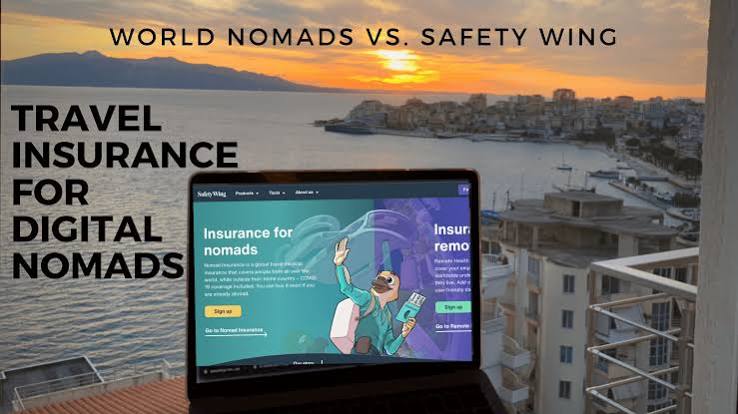
Providers in the nomad insurance category include SafetyWing (from ~USD 42/month), Genki, and World Nomads extended plans — always verify current pricing and terms directly with the insurer.
-
Working holiday visa countries such as Australia, New Zealand, and Canada may require specific minimum coverage amounts; confirm your policy satisfies visa conditions before travel.
What Is Nomad Travel Insurance and How Is It Different From Standard Travel Insurance?
Last updated: August 10, 2026
- A conventional travel policy caps individual trips at 30–90 days and assumes a fixed home you return to.
- Most conventional policies cap individual trips at 30–90 days.
- On day 91 in a country, you are likely uninsured.
- Certain policies cap consecutive stays in any single country — often at 90 days, mirroring visa rules.
Pack a suitcase, move between countries, extend your stay indefinitely — and standard travel insurance quietly stops protecting you. Built for a two-week holiday, it was never engineered for the way long-term travellers actually move. The gap between the two products is wider than most people realise, and crossing it with the wrong policy can mean a five-figure medical bill lands entirely in your lap.
A note before we start: this article explains how these products work. It is not financial or insurance advice. Your own situation — your health history, your home country, your travel pattern — determines what you actually need. A qualified insurance adviser or broker should be consulted before you buy any policy.
What Standard Travel Insurance Actually Covers (and Where It Stops)
Standard travel insurance is a trip product. It covers a defined journey: you leave, something goes wrong, you come home. The whole architecture is built around that arc.
The structural limits that matter for long-term travellers:
-
Trip duration caps. Most conventional policies cap individual trips at 30–90 days. Premium annual multi-trip options may extend to 180 days per trip, but that is the outer edge — not the norm. On day 91 in a country, you are likely uninsured.
-
Home country anchor. Standard policies assume you have a primary residence to return to. Coverage is calculated from that base. Give up your lease, sell your home, or simply fail to return within the policy window, and certain insurers may treat you as uninsured for the extension — though the exact treatment varies by insurer and jurisdiction. Consult a qualified insurance adviser or broker about your specific situation; the National Association of Insurance Commissioners can help locate licensed advisers in the US.
-
“Return home” clauses. Medical evacuation benefits in standard policies often require repatriation back to your country of residence as the resolution. Six months into travel with no intention — or no budget — to fly home for treatment? That benefit can actively work against you. Terms vary by policy; a broker familiar with long-term travel insurance can clarify how a specific evacuation clause applies before you commit.
-
Pre-existing conditions. Standard policies typically exclude ongoing or chronic conditions unless a specific rider is purchased, and those riders are often expensive and limited.
Quick check: Does your next trip end on a fixed return date, with a home to go back to? Standard travel insurance is probably sufficient. Fuzzy on either of those? Keep reading.
How Nomad Travel Insurance Works Differently
Sometimes called long-term travel insurance, expat insurance, or digital nomad insurance, this product category is designed around continuous travel rather than discrete trips. Three structural differences set it apart.
1. Rolling coverage, not trip-based coverage. Rather than insuring a journey with a start and end date, nomad policies insure a period of time — often a year, sometimes renewable — during which you can move between countries without restarting the clock or filing a new claim window.
2. No fixed home requirement. Because coverage follows you geographically, medical care can be sought in whatever country you happen to be in. That said, policy terms vary widely, and what constitutes “home” for exclusion purposes differs between providers; verify the definition in writing with any insurer you are considering. A licensed broker can help clarify how a specific policy handles this for your circumstances.
3. Country exclusion lists rather than country inclusion lists. Conventional travel insurance covers the trip you declared. Nomad insurance typically covers everywhere except an exclusion list — usually your home country, or countries with prohibitive healthcare costs for the insurer, like the United States or Canada, which are sometimes optional add-ons at higher cost.
The honest trade-off: nomad insurance costs more than a comparable multi-trip policy for the same calendar year, because the insurer is carrying a longer and less predictable risk window. Honestly, that premium gap can sting. These policies also commonly require you to spend fewer than a set number of days per year in your home country to remain eligible — a threshold that varies by insurer, so read the specific wording rather than assuming a standard figure.
Quick check: Moving countries more than two or three times a year with no fixed return date? Nomad insurance is the structural fit. Making one or two defined trips from a settled base each year? A conventional annual multi-trip policy is almost certainly cheaper and adequate.
The Conditions That Change Which Product Is Right
Your SituationBest PathWhy the Other Option Fails
Fixed annual leave travel, 2–3 trips, permanent home base
Standard annual multi-trip policy
Nomad insurance adds cost and country-exclusion complexity you do not need
Sabbatical or gap year, 6–12 months, single continuous trip
Long-term travel or backpacker policy
Standard policies cap at 90 days; nomad policies may require renouncing home residency to qualify
Full-time nomad, no fixed home, multiple countries per year
Nomad / digital nomad insurance (e.g. SafetyWing, World Nomads extended, Genki)
Standard policies require a declared trip; you have no such thing
Expat with a fixed contract abroad, employer not providing coverage
International health insurance (IPMI)
Nomad insurance is travel-focused; IPMI provides ongoing primary healthcare coverage more appropriate for settled expats
Frequent traveller who includes the US regularly
Nomad policy with US coverage add-on, verified in writing
Many nomad base policies exclude the US due to cost; assuming coverage is a dangerous default
Quick check: Which row describes you most closely? The product category in that row is your starting filter — not your final answer, but the right category to shop within.
Nomad Insurance vs. The Alternatives

This type of coverage sits in a spectrum of products. Understanding where it fits helps you avoid buying the wrong one.
vs. Standard annual multi-trip insurance: These policies cover multiple trips per year from a settled base, typically capping each trip at 30–90 days. Cheaper for the same calendar year — well, usually cheaper — but the per-trip cap and home-base assumption make them structurally unsuitable for full-time travel.
vs. International Private Medical Insurance (IPMI): IPMI functions as full health insurance abroad — covering primary care, specialist visits, and ongoing condition management, not just emergencies. Right product for settled expats or people managing chronic conditions. Also substantially more expensive; annual premiums for comprehensive IPMI plans can run USD 2,000–8,000 or more depending on age, region, and coverage level. Nomad insurance suits healthy travellers moving frequently. IPMI suits longer-term residents abroad who need consistent primary care access.
vs. Backpacker or gap-year insurance: These are essentially long-duration travel policies — often covering 12–18 months — sold to people on a single extended trip rather than continuous nomadic movement. They tend to cost less than nomad insurance, but may not accommodate re-entry to your home country for short visits without pausing or voiding coverage. Doing one long trip with a clear end date? A backpacker policy may be more economical than a nomad product.
vs. Credit card travel insurance: Certain premium credit cards bundle travel insurance as a benefit. Coverage limits are generally low (often capped at 30–60 days per trip), and medical maximums are frequently USD 25,000–50,000 — far below what a serious medical event abroad can cost. Useful as a secondary layer; not a primary policy for long-term travel.
Shopping for Nomad Insurance: How to Evaluate a Policy
Most comparison failures happen because people compare headline prices without checking the structural terms. These steps are worth following before buying anything.
-
Confirm the maximum trip duration and whether it is per trip or per policy year. Certain policies cap consecutive stays in any single country — often at 90 days, mirroring visa rules. Planning to base yourself in one place for extended stretches? Verify this specifically.
-
Read the home country definition and the residency requirement. Policies differ on whether “home country” is your passport country, your country of tax residency, or your last permanent address. Recently moved, or holding dual citizenship? Get clarity in writing.
-
Confirm whether the US and Canada are included, excluded, or available as add-ons. These markets carry higher healthcare costs and are frequently excluded from base plans. Any chance you will spend time there — verify this before you buy, not after you land.
-
Look at the medical evacuation trigger. Some policies evacuate you to the nearest adequate facility. Others route you back to your country of residence. For a nomad, that destination may not be where you want to end up. Know which clause applies.
-
Review pre-existing condition terms. Nomad policies vary widely here — some exclude all pre-existing conditions, some cover stable conditions after a waiting period, some offer a rider. Any ongoing condition makes this the most important clause in the document, not the premium.
-
Verify the claims process for the countries you visit most. Some insurers require pre-authorisation for non-emergency care. In countries where the insurer has no direct billing arrangement, you may pay upfront and reclaim later — which requires both liquidity and careful documentation.
Quick check: Have you read the actual policy wording — not the marketing summary page — on at least points 1, 2, and 5 above? Not yet? Don’t buy yet.
Edge Cases That Change the Calculation
1. Tax residency in a high-cost country, even while living abroad. Certain nomad insurers use tax residency — not physical presence — when defining your “home country.” Your home country may be excluded from coverage entirely, or covered only as a limited add-on. Read that definition carefully. An IPMI policy may be the better fit here.
2. Travelling long-term with a chronic or serious pre-existing condition. Nomad travel insurance is generally not designed as primary health coverage for people managing ongoing conditions. Exclusions can be broad, caps on related claims can be low, and “stable for X months” provisions vary dramatically between insurers. For this profile, international private medical insurance — closer in function to a health product than a travel product — is worth investigating seriously, alongside consultation with a specialist broker.
3. On a working holiday visa. Working holiday visas in countries like Australia, New Zealand, and Canada sometimes have insurance requirements baked into the visa conditions — requiring specific coverage types or minimum benefit amounts. Generic nomad policies may or may not satisfy these. Review the visa requirements directly before assuming your policy qualifies.
4. Crossing in and out of your home country frequently. Many nomad policies allow short home-country visits, often capped at a set number of days per year. Regular returns for family or work mean the cumulative day count matters. Exceeding the threshold can void coverage for the entire policy period with some insurers — not just for the overstay. Worth verifying in writing; this clause catches people off guard.
5. Crew members, expedition participants, or regular adventure sports participants. Standard nomad insurance typically excludes professional sports, extreme sports, and certain high-risk activities. Some providers offer adventure sports riders; others do not cover them at all. Skiing, diving, motorcycling, or similar activities as a regular part of your travel pattern — not an occasional detour — demand a close read of what any rider actually covers.
6. Travel involving conflict zones or high-risk regions. Both standard and nomad insurance typically exclude countries listed under severe travel advisories by your government. Work or travel taking you to such regions requires specialist hostile environment insurance — an entirely different product category from anything discussed here.
The Honest Limitations of Nomad Travel Insurance
Nomad travel insurance solves a real gap. But the marketing rarely volunteers its limits.
Not full health insurance. Develop a chronic illness while abroad, and most nomad policies will cover the acute phase — then stop. Ongoing primary care coverage for managing that condition long-term falls outside what these products do. A new diagnosis can push you into a coverage gap neither you nor the policy anticipated.
On renewability: some nomad policies can decline to renew, or exclude newly developed conditions at renewal. Read the policy wording on this before you commit, because policies differ sharply on the point. Comprehensive domestic health insurance in many countries carries legal guaranteed-renewability protections — though the specifics depend on jurisdiction, and a broker or the relevant regulatory body in your country can clarify what applies to your situation.
Because that renewability risk is real, the premium difference also deserves attention. A year of US-inclusive nomad coverage can cost meaningfully more than a year-long multi-trip policy covering the same period; that math stops working fast if you are only crossing borders once or twice a year. The gap is not arbitrary — it reflects the risk the insurer is taking on. Running the two numbers side by side before deciding is worthwhile.
The best policy you do not understand is worse than a simpler one you do. Insurance documents are legal contracts; reading the exclusions before purchase is not optional. It is the job.