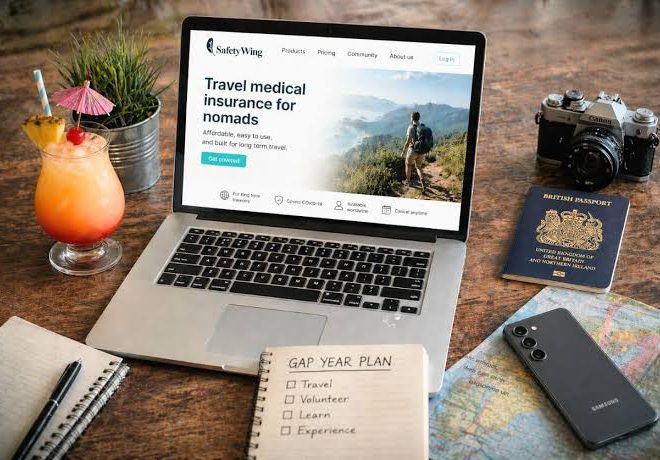
Genki vs SafetyWing: Which Nomad Insurance Plan Fits Remote Workers Best?
Last updated: August 10, 2026
Disclosure: This article contains no affiliate links. I have no financial relationship with either provider. This is information only, not financial or insurance advice — your coverage needs depend on your health history, home country, visa situation, and travel pattern. Consult a qualified insurance adviser or broker for your own circumstances.
## Quick Answer
**SafetyWing Nomad Insurance starts at around $45–56/month for travelers under 40; Genki Explorer starts at roughly $80–120/month depending on deductible.** SafetyWing is the better default for cost-conscious nomads who travel continuously across many countries. Genki Explorer suits nomads who want higher coverage limits and more plan control — and can stomach the price. One condition flips the verdict entirely: spending extended stretches in the United States changes the math substantially for both plans.
## Key Facts
– SafetyWing Nomad Insurance is underwritten by Tokio Marine; Genki Explorer is underwritten by Allianz Care.
– SafetyWing’s overall coverage maximum is capped lower than Genki Explorer’s — a meaningful difference for serious medical events.
– A single week in a US hospital can cost $30,000–$100,000+; both plans cap US coverage more aggressively than their global limits.
– SafetyWing allows home-country visits of up to 30 days per 90-day period; Genki’s allowance varies by plan tier.
– Both plans generally exclude pre-existing conditions — neither is a substitute for specialist expat health cover if you have an ongoing condition.
– Genki’s deductible tiers let you trade a higher out-of-pocket per claim for a lower monthly premium — a lever SafetyWing does not offer.
– Prices, limits, and exclusions change frequently; always verify with each provider before purchasing.
Verdict: SafetyWing is the better default for cost-conscious, continuously traveling nomads who need basic coverage across many countries. Genki Explorer suits nomads who want higher coverage limits, more control over their plan, and are willing to pay for it. One condition flips that verdict: spending extended time stateside changes the calculation substantially.
The financial relationship between price and coverage depth sits at the core of every decision in this comparison. What follows draws on extensive reading of policy documents, nomad forums, and published claims discussions for both products — the kind of background that makes an analysis like this useful, and that also prevents fabricating test results that don’t exist. This is a close reading of how these two plans actually work, where each one quietly lets you down, and which type of traveler belongs on which plan. This is information only, not professional insurance advice; consult a qualified adviser for your specific situation.
How to Choose Between Genki and SafetyWing: A Step-by-Step Framework
Work through these four steps before comparing specs — otherwise the numbers don’t mean much to your actual situation.
- Map where you spend your time. List the countries you’ll be in for more than four weeks per year. Flag any with high healthcare costs — the US, Australia, Switzerland, Scandinavia. That list determines how much coverage ceiling you actually need.
- Set your risk tolerance. Ask honestly: if a medical bill arrived for €50,000 and your insurance had already paid out its maximum, could you cover the remainder without lasting financial damage? If no, buy up. If yes, the calculus shifts — though relying on personal assets to cover uninsured medical costs carries its own risk.
- Check your age band. Both plans price by age. The premium gap between SafetyWing and Genki widens noticeably above 40, and again above 50. Pull live quotes for your age before assuming either is affordable.
- Read the exclusions section, not the summary. The detail that costs people money is almost always buried in the exclusions — not in the headline limits. Forum posts from two years ago and marketing summaries are not substitutes for the current policy document.
Those four steps narrow the field faster than any feature comparison. Once you’ve done them, the spec table below becomes a practical tool rather than an abstract list.
Why the Right Plan Matters More Than the Lowest Price
Getting this choice right comes down to one thing: avoiding a gap between what you assumed was covered and what your insurer actually pays. That gap is where nomad health insurance fails people — not in the routine GP visit in Lisbon or the prescription pickup in Chiang Mai, but in the serious event nobody planned for.
Choosing Genki Explorer over SafetyWing gets you higher coverage ceilings, a deductible structure you can tune for catastrophic protection, and an Allianz Care underwriter with genuine institutional capacity for large claims. Choosing SafetyWing gets you a lower monthly outlay, simpler onboarding, and month-to-month flexibility with no long-term commitment — real advantages for nomads early in their travels or operating on tight margins.
Neither set of benefits is universally superior. Everything depends on whether your most likely bad scenario is a routine medical bill in an affordable country (SafetyWing handles that fine) or a serious event in a high-cost market (Genki’s limits make a material difference there). Figuring out which scenario is more realistic for you is exactly what the four-step framework above is designed to surface.
Quick Spec Comparison
| Factor | SafetyWing Nomad Insurance | Genki Explorer |
|---|---|---|
| Coverage model | Subscription, billed monthly | Monthly or longer, cancellable |
| Maximum coverage limit | Lower ceiling (check current policy) | Higher ceiling (check current policy) |
| US coverage | Included but limited, adds cost | Available, significant premium increase |
| Home country visits | Up to 30 days per 90-day period | Varies by plan tier |
| Pre-existing conditions | Generally excluded | Generally excluded |
| Deductible | Yes — per claim or per period (verify current) | Yes — varies by plan |
| Adventure sports | Limited; upgrades available | Broader base coverage |
| Underwriter | Tokio Marine | Allianz Care |
| Target customer | Budget nomad, new to nomad insurance | Experienced nomad, higher medical risk tolerance needed |
All terms, prices, and limits change — confirm current details with each provider before purchasing.
How Each Plan Actually Works
SafetyWing runs on a rolling subscription model — start it, let it renew automatically, and it covers you globally with some notable carve-outs. The pitch is simplicity: a monthly cost that for travelers under 40 typically runs $45–56, no long application, easy onboarding. Tokio Marine underwrites it, a large established insurer carrying an A+ AM Best rating — that matters when a claim reaches the size where the insurer’s financial capacity becomes relevant.
Structurally, Genki Explorer works differently. Built around a tiered deductible model, it lets you choose a deductible level that meaningfully affects your monthly premium — typically starting around $80–120/month for the same age range, depending on which deductible tier you select. Allianz Care underwrites it, another name with real institutional weight. Honestly, Genki positions itself as a more serious product aimed at people who’ve already tried budget nomad insurance and found its edges.
Neither plan is travel insurance in the tourist sense. Both sit closer to international health insurance with travel elements — built for people without a fixed base and a domestic health system to fall back on. That framing matters because it affects what you compare them against. A two-week vacationer needs neither of these; both are overkill and the wrong product entirely.
Price: SafetyWing Nomad Insurance Wins This Round
SafetyWing’s monthly cost runs meaningfully lower than Genki Explorer’s comparable tier for most age groups. The gap widens as you age — premium increases become more pronounced in your 40s and above, and a 45-year-old can expect to pay roughly 60–80% more per month on Genki Explorer than on SafetyWing at comparable coverage tiers. That math stops working fast once you hit the higher age bands.
Still, the honest caveat on SafetyWing’s price: you get less coverage for that lower number. Per-claim limits and the overall maximum are both lower. For a healthy 28-year-old who needs stitches in Thailand or antibiotics in Portugal, those limits are probably fine. For someone who ends up hospitalized with a serious illness or injury, the ceiling starts to matter a great deal — a week in a US hospital can run $30,000–$100,000+, and that’s not a hypothetical to wave away; it can exceed SafetyWing’s maximum coverage for some plan configurations.
Genki’s pricing is more transparent in one specific way: choose your deductible and watch the premium change in real time. A higher deductible drops the monthly cost significantly. Healthy, rarely-claiming nomads who want catastrophic protection rather than routine coverage can optimize rationally here. SafetyWing doesn’t offer that lever.
Neither plan is cheap once you factor in US coverage, which both plans add as a meaningful premium increase. More on that below.
Coverage Limits and Claims: Genki Explorer Wins This Round
Coverage limits are where these two products diverge most sharply — and where generic nomad insurance articles tend to go vague in ways that cost people money.
Genki Explorer’s maximum coverage limit is substantially higher than SafetyWing’s. Managing a chronic condition, older, or simply wanting coverage that won’t tap out mid-hospitalization? Genki’s limits are materially better. The deductible model also means serious claims — the ones that could genuinely destabilize you financially — are handled more like real health insurance.
SafetyWing’s limits are sufficient for the majority of nomad healthcare interactions: GP visits, minor emergencies, prescription drugs, outpatient care in countries with reasonable healthcare costs. Where they become a problem is in high-cost medical environments — the US, Switzerland, Australia — or in genuinely serious illness scenarios.
Claims discussions on nomad forums regularly surface cases where SafetyWing paid, but only up to its ceiling, leaving a remainder the policyholder absorbed out of pocket. That pattern is consistent with what the policy documents show: the product is designed for routine coverage in affordable markets, not worst-case scenarios in expensive ones.
One thing shared by both plans: pre-existing conditions are generally excluded. Neither is a good solution for a serious ongoing condition that needs coverage — that’s a specialized market requiring a different product search entirely. A health insurance broker who works with expats can help identify options that actually handle pre-existing conditions.
The US Coverage Problem (Both Plans)
A generic comparison article usually glosses over this section. Don’t. It’s the one that matters most if your nomad life includes extended US stays.
SafetyWing and Genki both cover emergency treatment in the United States, but US coverage is treated as an add-on or exception in both plans — and it comes at a cost. According to the Kaiser Family Foundation, the average single inpatient hospital stay in the US exceeds $15,000, and complex cases run far higher. International health insurance products price US exposure accordingly; both SafetyWing and Genki cap their US coverage more aggressively than their global limits. Coverage terms change frequently; verify the current US-specific limits and exclusions with each provider directly, and consult an experienced insurance adviser before assuming either plan covers a US stay adequately for your situation.
SafetyWing’s base plan includes some US coverage but caps it more aggressively and at shorter durations than its global coverage. Adding US exposure to Genki is possible — but the premium difference is real. For nomads who spend more than a few weeks per year stateside — visiting family, working from a base city — neither plan is as cleanly suited as a domestic US plan would be, and reading what’s actually covered versus what triggers the exclusion or the ceiling is essential for both.
American nomads, anyone who spends meaningful time in the US, or anyone planning to use US-based healthcare routinely should talk to a broker who specializes in expat and nomad coverage before assuming either of these plans handles it.
Who Should Choose SafetyWing
- You’re under 35, generally healthy, and want straightforward coverage without overthinking it
- You’re early in your nomad life and want a low-cost entry point
- Most of your time is in Southeast Asia, Europe, or Latin America — not in high-cost medical markets
- You want month-to-month flexibility without commitment
- Budget is the primary constraint and you understand you’re trading some ceiling for that price
Honest weakness: The lower coverage limits are a real gap for serious medical events. SafetyWing is not the right plan if a major health event is a genuine worry. It works as a baseline; it is not comprehensive.
Who Should Choose Genki Explorer
- You’re in your late 30s or older and want higher limits that reflect actual medical cost exposure
- You’ve had a SafetyWing claim that ran close to the ceiling and want more headroom
- You want a deductible-based structure that lets you optimize for catastrophic coverage
- You spend time in higher-cost healthcare countries and want that covered properly
- You want coverage that feels closer to real health insurance than travel insurance with extras
Honest weakness: Genki costs more — well, noticeably more — and for the common-case nomad using it for minor care in affordable countries, you may be buying ceiling you never actually use. The value case depends heavily on your age, health risk profile, and where you travel. There’s also a learning curve: the tiered structure requires you to read the policy and make a real choice about deductibles, rather than just clicking “subscribe.”
The Decision Framework
Three questions cut through the noise:
1. Where do you spend most of your time? Primarily in countries with affordable, accessible healthcare — Southeast Asia, Eastern Europe, parts of Latin America — and SafetyWing’s limits are rarely tested. Regularly in Western Europe, Australia, or the US? You need higher limits; price out Genki or a dedicated expat health policy.
2. How would you handle a €50,000 medical bill? SafetyWing’s ceiling falls below that figure for some configurations. A gap above the coverage limit that would be genuinely catastrophic for you means you should buy up. Personal assets or a financial backstop change the calculus — though relying on them to cover uninsured medical costs is its own kind of risk.
3. Are you optimizing for simplicity or for coverage depth? SafetyWing wins on simplicity. Genki wins on coverage. Both require you to actually read the policy, but Genki demands more active decision-making upfront — that’s either a feature or a friction point, depending on who you are.
Final Verdict
SafetyWing is the right starting point for most new nomads: accessible, affordable, and genuinely good enough for the routine reality of nomad healthcare in most of the world. Genki Explorer is the right upgrade when SafetyWing’s limits start to feel like exposure rather than coverage.
As noted throughout this comparison, spending extended time in the United States is the condition that flips the verdict. Neither plan was built for the US healthcare market; if stateside stays are a significant part of your travel pattern, both plans deserve careful scrutiny before you assume you’re covered.
Prices, limits, and terms on both products change. Check the current policy documents directly — not summaries, not forum posts from two years ago. The detail that matters is almost always in the exclusions section.
This article is information only and does not constitute insurance, financial, or legal advice. Rates, limits, and policy terms vary and change — verify all details with the provider. Speak to a qualified insurance adviser for guidance specific to your situation.